
Buying a Condo in Denver? Check the Building Before You Write the Offer.

Loan guidelines described here are current as of August 2026 and change periodically. Ask your loan officer what applies to your file.
Most Denver-area condo purchases close on ordinary financing without incident. That's worth saying up front, because what follows is a list of things that can go wrong, and it would be easy to finish this article thinking condos are landmines. They aren't.
But condos carry one layer of homework that houses don't, and when it goes wrong it goes wrong late — three weeks before closing, after the inspection, after you've paid for an appraisal. Almost all of it is checkable earlier. Here's how.
This question changes everything else in this article, and a surprising number of buyers don't know the answer about the place they're touring.
A condominium means you own the interior of your unit and share ownership of the building and grounds with everyone else. Condos get a project review — the lender evaluates the building and the HOA, not just you.
A townhome or row home platted as a PUD means you own your unit and the land under it, in fee simple. There's still an HOA, still dues, still shared amenities. But for most conventional loans, PUD projects get a review waiver. No HOA questionnaire hunt, no warrantability question, none of the five problems below.
Here's the catch: they look identical from the street. Denver metro is full of attached townhome-style homes, and some are condos and some are PUDs. Central Park, Green Valley Ranch, Arvada, Lakewood — you'll find both.
How to find out in two minutes: ask your agent to check the property subtype in the MLS, or look at the title commitment or the recorded plat. A condominium map and a subdivision plat are different documents. Your loan officer can also tell you from the address.
If it's a PUD, most of what follows doesn't apply to you and you can relax. If it's a condo, keep reading.
When you buy a house, the lender evaluates you — income, credit, assets — plus an appraisal.
When you buy a condo, there's a second evaluation of the project: the building, the HOA, its budget, its insurance, and whether anyone is suing anyone.
The reason is that most conventional mortgages get sold to Fannie Mae or Freddie Mac after closing, and they have rules about what they'll buy. A condo project meeting those rules is warrantable. One that doesn't is non-warrantable.
Non-warrantable doesn't mean you can't buy the place. It means conventional financing is off the table and you're looking at more specialized options, which take longer to arrange. That's a very different conversation in week one than in week three with a closing date on the calendar.
One more thing worth knowing: warrantability is decided per loan and per lender, not stamped on a building permanently. One decline doesn't always mean the building is dead — and a building that's fine today can go non-warrantable later if litigation gets filed or an insurance renewal drops coverage below standard. That affects your ability to refinance and the pool of buyers you can sell to down the road.
This is the part most condo guides skip, and it's the most useful thing in this article.
Once you're under contract on a Colorado property with an HOA, the standard Contract to Buy and Sell gives you real protection:
The seller delivers the Association Documents at the seller's expense, by the Association Documents Deadline (§7.2). Not at your expense, and not as a favor.
The list is broad (§7.3) — declarations, articles, bylaws, rules, meeting minutes, a list of all Association insurance policies, assessment lists, budgets, financial statements, audit results, and written notice of any construction defect claims. That's considerably more than most buyers ask for.
You can terminate based on any unsatisfactory provision in those documents, in your sole subjective discretion (§7.4), with your earnest money returned. That is the broadest exit in the contract. You don't have to justify it.
If the documents arrive late, your clock extends — generally ten days after you receive them, or until closing, whichever comes first. If you don't terminate in time, you've accepted them.
There are separate loan deadlines (§5.2.1 and §5.2.2) covering whether the loan terms work for you and whether the lender's underwriting comes back satisfactory. Read §5.2.2 carefully with your agent: if you don't deliver written notice to terminate on time and the seller isn't in default, your earnest money becomes nonrefundable.
That last point is the real financial risk in a condo purchase. If project review comes back non-warrantable after your loan deadline has passed, you're in default and your earnest money is on the line. This is why timing matters — not because deals fall apart, but because of who pays when they do.
The practical takeaway: these deadlines are blanks on a form. They get pre-filled with day counts sized for a single-family house. On a condo, ask your agent to lengthen the Association Documents and loan deadlines before you sign. It's free, and it's the single most protective thing you can do.
Be prepared for a wall here. Colorado gives you no right to HOA documents before you're under contract — the seller's obligation is contractual, and management companies generally won't release a package to someone who isn't an owner or under contract. The documents also cost money, often a few hundred dollars, and the seller has no reason to spend it on a stranger.
So the honest answer to "can I see the budget before I offer" is often "not until we're under contract." Here's what you can usually get anyway:
1. Ask what the seller already has. Many owners have the budget, recent minutes, and last year's insurance summary sitting in a drawer or an owner portal. Costs nothing to ask.
2. Ask what's closed in the building recently, and how it was financed. Your own agent can pull this from the MLS in a few minutes — a more neutral source than the listing agent. Look back twelve to twenty-four months; small buildings may have no sales in six. Several conventional closings is a useful sign, though not a guarantee, since anything that closed before August 2026 was reviewed under a lighter standard than applies now. If everything sold to cash buyers, ask the listing agent why, and treat "I don't know" as an answer in itself.
3. Ask who manages the building and how fast they return lender questionnaires. This is the single best predictor of whether your closing date is realistic. The most common reason condo deals stall isn't a bad answer on the form — it's a management company taking three weeks to send the form back at all.
4. Ask about litigation, in writing, and ask broadly. Lenders want to know about pending and threatened claims, not just filed lawsuits. Ask in those terms, and get the answer from the HOA or its manager rather than relying on a verbal "no" from a seller who may genuinely not know.
5. Ask about special assessments the board has discussed — not just ones already levied. A vote that hasn't happened yet still hits your budget. This lives in the meeting minutes, which is one more reason to get those early.
6. Send whatever you get to your loan officer. Someone who reads these documents regularly can often flag a problem early that would otherwise surface in week three.
7. Build the timeline in. Under the current review requirements, the HOA has more paperwork to produce than it used to. Talk to your loan officer about realistic contract dates before you sign, not after.
None of these are about your finances.
1. Underfunded reserves. An association that keeps monthly dues low is sometimes doing it by underfunding the reserve account. Lenders read that as a large special assessment waiting to happen — one a brand-new owner may not be able to absorb. This is one of the most common problems we see.
2. Delinquent owners. If more than 15% of the units in a project are 60 or more days past due on assessments, the project is ineligible — not concerning, ineligible. A similar test applies to each special assessment.
3. Litigation. If the HOA or the developer is named in pending litigation relating to the safety, structural soundness, habitability, or functional use of the project, the project is ineligible for conventional financing. That's categorical, not a judgment call. Some minor matters are carved out — non-monetary disputes, collection actions against delinquent owners, a covered claim the insurer has agreed to defend — but the carve-outs all depend on the matter having no bearing on safety, soundness, habitability or use. An insurance carrier agreeing to defend does not rescue a structural-defect suit.
This matters more in Colorado than in most states. Construction-defect litigation on attached housing is well documented here and it reshaped what got built — Denver-metro condos went from roughly a third of multifamily starts in the mid-2000s to a small fraction in the years after. Colorado law in this area has changed recently, so the landscape isn't static, but the existing housing stock is what it is.
4. Insurance problems. Coverage amounts, deductibles, and whether the master policy meets loan requirements. HOA insurance costs have climbed hard in Colorado, and some associations responded by taking coverage that no longer satisfies lenders. One consequence lands directly on you: where the master policy carries a per-unit deductible, you'll generally need your own unit-owner policy with coverage at least matching that deductible. That's real money at closing that buyers rarely budget for.
5. Deferred maintenance. Known structural problems the association hasn't addressed. This shows up in meeting minutes and in a reserve study's condition assessment — another reason to read the minutes rather than skim the budget.
All of this surfaces through the HOA questionnaire, a form your lender sends to the association or its management company. It's routine. It's also where condo deals most often stall.
Short version, because it affects your timeline.
There used to be an abbreviated review for many condo loans — fewer documents, faster answer. For applications dated August 3, 2026 or later, that shortcut is retired for established projects. Freddie Mac dropped its equivalent the same day.
Small projects got something in return: the review waiver expanded to cover projects of ten or fewer units. But a waiver isn't "no review" — the project still has to meet insurance requirements, can't be flagged unavailable, can't have unaddressed critical repairs, can't be a condo-hotel or timeshare, and for five-to-ten-unit buildings can't be part of a master association or larger development.
Two other changes worth knowing: since July 1, 2026 a master policy's per-unit deductible is capped, and starting January 4, 2027 the reserve allocation lenders look for rises. Read that second one carefully — it's a standard for whether a building is financeable, not a legal requirement on the association. Nobody can make an HOA comply. An association that declines simply becomes harder to buy in.
What it means for you: more paperwork from the HOA, and HOAs move at their own pace. Build extra time into your dates.
FHA runs a separate condo approval process. The owner-occupancy minimum is generally 50% for an existing project, lower for projects still under construction, and lower still for existing projects meeting certain financial conditions.
A building can be fine for a conventional loan and fail FHA approval, or the reverse. So "which loan should I use" is partly a question about the building, not just about you.
Free thirty-second check: HUD publishes a searchable list of FHA-approved condo projects. Look up the address before you go further.
Not the end. Your options generally look like:
The point is that finding out early gives you choices. Finding out late gives you one.
This article is general information about mortgage lending guidelines. It is not legal, insurance, or tax advice, and it is not a commitment to lend or an offer to extend credit. Guidelines change and are applied to each file individually. For questions about an HOA's governing documents, its insurance coverage, its litigation, or your purchase contract, consult a licensed Colorado attorney, insurance professional, or your real estate broker.

Family help only counts if it's documented the way your loan program requires. Who can give it, what the gift letter needs, and why the order matters.


Business owners get told they don't make enough all the time — usually because the lender is reading a different number than they are. Here's which one.

Buying a home from a family member? A gift of equity may allow an eligible seller to use some of the equity already in the home to help with your down payment and certain closing costs. Learn how it works and why planning ahead matters.

Thinking about buying a home after divorce? Learn what to expect, how divorce may affect your mortgage, and why understanding your options early can help you move forward with confidence.

If you're eligible for a VA loan, should you always use it? Learn why some veterans compare conventional financing, when it may make sense, and why the best mortgage depends on your financial goals—not just your eligibility.

Learn how mortgage contingencies and financing deadlines work, how they may affect earnest money, and what Colorado buyers should consider before limiting an important contract protection.

Should you pay upfront to lower your mortgage interest rate? Learn how mortgage discount points work, how to calculate your break-even point, and when buying points may—or may not—be the right financial decision.

A successful home purchase is about more than finding the right property. Learn why having a thoughtful strategy—and a team that helps you understand your options—can make a meaningful difference throughout the buying process.

Wondering if your mortgage pre-approval expires? Learn how long a pre-approval typically lasts, when updates are needed, and what changes could affect your eligibility.

Many Veterans know the basics of the VA loan program, but few realize just how flexible the benefit can be. Here are some of the most common surprises Veterans discover when they take a closer look at their home loan options.

Most buyers focus on the house itself during a showing, but the factors that determine long-term happiness often have little to do with countertops, paint colors, or staging. Learn how experienced buyers evaluate a home beyond first impressions and what really matters after move-in day.

What is the VA funding fee, why does it exist, and who has to pay it? Learn how VA funding fees work and why they help support one of the strongest loan programs available.

What is a 2-1 buydown, and is it actually worth it? Learn how temporary buydowns work, their pros and cons, and what buyers should consider before using one.

What do homeowners regret most after buying a home? From stretching budgets too far to overlooking long-term lifestyle needs, here are the lessons many buyers wish they knew earlier.

Two buyers can purchase the same home and end up with very different monthly payments. Here’s why—and what it means for your buying strategy.

FHA loans offer flexibility for first-time buyers—but they’re not one-size-fits-all. Learn how they work, their benefits, and what to consider before choosing this option.

First-time homebuyer programs aren’t just about getting into a home—they’re about doing it strategically. Learn how these programs work, who they’re for, and how they can help you buy with confidence.

You’ve built equity in your home—but what does that actually mean for you? Learn the smartest ways to use (or not use) your equity and how to decide what makes sense for your situation.

Thinking about using your 401(k) for a down payment? It’s possible—but it comes with trade-offs. Here’s what homebuyers should understand before tapping into retirement savings.

Your tax refund could be more useful than you think when preparing to buy a home. From boosting your down payment to paying off debt and improving your debt-to-income ratio, here are smart ways buyers use their tax refunds to strengthen their mortgage approval.

Many homebuyers assume student loans automatically prevent them from qualifying for a mortgage. In reality, lenders evaluate several factors beyond just the loan balance. Here’s what actually matters when applying for a home loan with student debt.

If you’ve served our country, you’ve earned more than a handshake. A VA home loan can be one of the most powerful benefits available to eligible veterans, active-duty service members, and surviving spouses. Here’s how it works — and what to know before you use it.

HOA fees are common in the Denver metro area — especially with condos and townhomes. Here’s what buyers should know about costs, rules, financial health, and how HOAs can impact your mortgage approval.

Thinking about upgrading but don’t want to give up your low interest rate? Here’s what happens to your mortgage if you move and keep your current home as a rental — including occupancy rules, qualifying for your next loan, and how rental income can offset your current payment.

Property taxes can feel confusing and stressful, especially when they change. Here’s a clear, no-panic breakdown of how property taxes really work and what homeowners should expect.

From accepted offer to closing table, here’s what really happens during the home-buying timeline — and how the right lender can help you close faster without cutting corners.
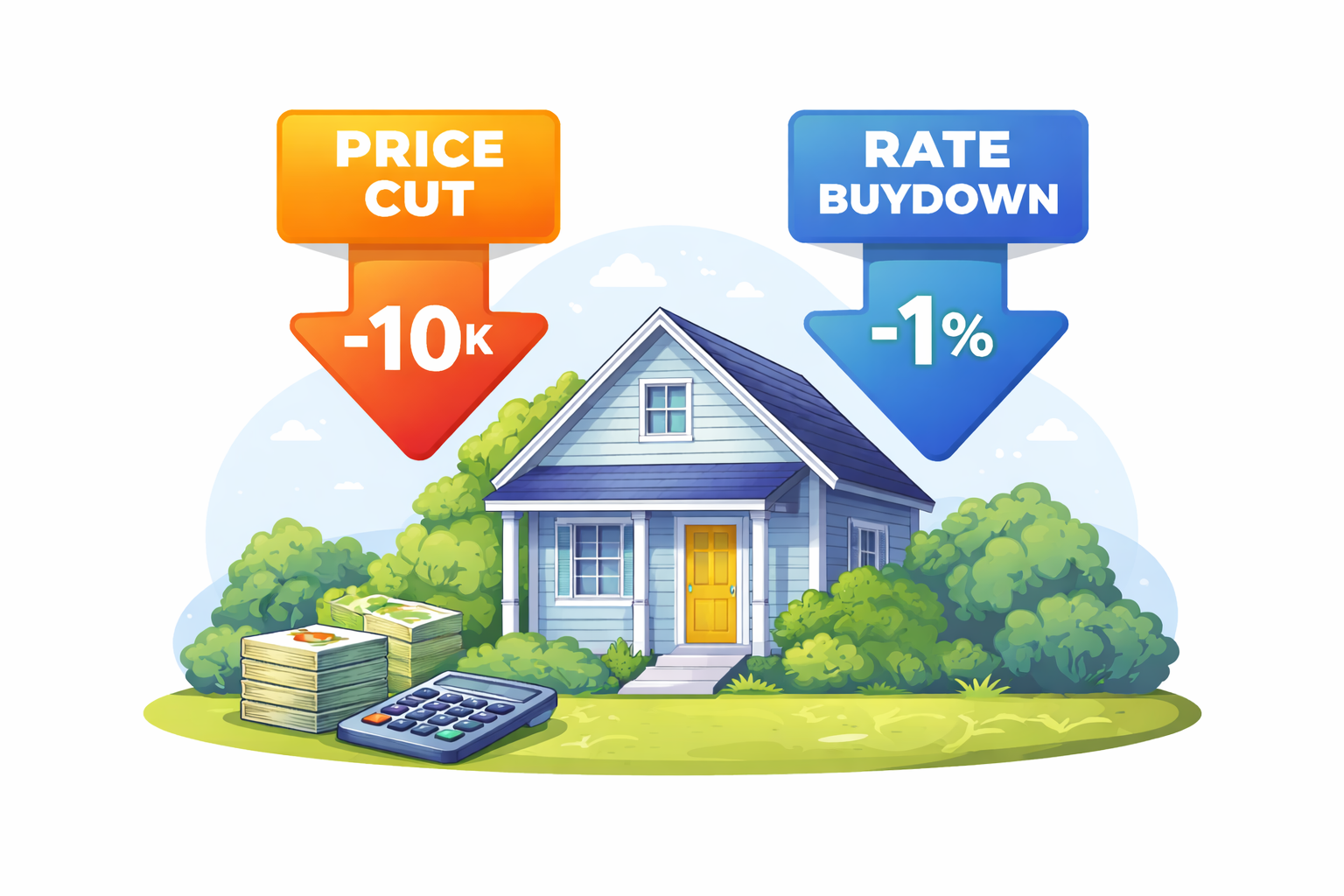
Seller concessions can do more than lower your cash-to-close. When used for a temporary or permanent rate buydown, the same $10K can often reduce your monthly payment more than a $10K price cut.

If you’re shopping homes based on price alone, you’re doing it the hard way. Here’s how to reverse-engineer your home search from a monthly payment you can actually live with.
First-time buyers aren’t buying at 28 anymore. The typical first-time buyer is now 40—and it’s a direct reflection of today’s affordability math, not a personal failure.

Old-school homebuying advice can keep you stuck or push you into a payment that doesn’t fit. Here are the most common “rules” we still hear—and the real-world guidance that works in today’s market.

A clear guide to earnest money: what it is, typical deposit amounts, who holds it, when it’s refundable, and how to protect your funds so your offer stays strong.

Has your mortgage payment jumped—or stepped up? Learn why payments change, from escrow shifts (insurance/taxes) to mortgage insurance removal to temporary buydowns ending, and what to do next.

Avoid the pitfalls most first-time buyers don’t even see coming until it’s too late. Here’s the real advice your future self will thank you for.

Owning a home comes with more than just pride and a mortgage payment. It can also open the door to meaningful tax benefits—from deductions to credits to exclusions. Here’s what to know, without the jargon.

A clear breakdown of what a home equity loan is, how it works, when it makes sense, and the key pros and cons to weigh before borrowing against your home.

Your credit score doesn’t have to be a mystery — or a roadblock. In this post, we break down exactly how credit works, what impacts your score the most, and what steps you can take today to boost it. Whether you’re getting ready to buy a home or just want more financial freedom, this guide gives you the clarity and confidence to take control.

Choosing between a 15-year or 30-year mortgage? This post breaks down the pros and cons of each option—payment differences, interest savings, equity timelines—and helps buyers decide which term fits their goals, lifestyle, and budget.

VA loans are one of the most powerful benefits available to veterans and service members—but most people don’t realize just how much they offer. In this post, we break down the top advantages of VA loans, from zero down payment to flexible credit guidelines, and how to put them to work for your next home purchase or refinance.

Moving before the school year starts? This guide breaks down what families need to know when buying a home on a tight timeline—including how to research school zones, plan backward from your move-in date, and avoid common missteps during the transition.

Learn the real costs of buying a home beyond the down payment. From closing costs to move-in expenses — here's how to budget like a pro.

With high home prices and rising rates, more buyers are teaming up to afford homeownership—especially in pricey markets like Colorado. This blog breaks down the pros, pitfalls, and property types perfect for co-buying with friends or family. From duplexes to ADUs, we’ll walk you through how to do it right—and what to avoid.

Confused by escrow? You’re not alone. This blog breaks down what escrow is, how it works during the homebuying process, and why it’s a key safeguard for your money and peace of mind—before and after closing.

Still think you need 20% down or perfect credit to buy a home? Think again. This post busts the most common myths that keep smart buyers on the sidelines—and shares what’s actually possible in today’s market. If you’re closer to buying than you think, this is the clarity you’ve been waiting for.

Sick of rising rent, slow repairs, or living on someone else’s terms? This post breaks down what renters won’t miss when they finally make the move to homeownership—and the freedom, stability, and financial benefits that come with it. If you’re wondering whether it’s time to buy, start here.
.png)
If you’re a veteran, active-duty service member, or surviving spouse, you may qualify for one of the best loan options available: the VA loan. This post breaks down the benefits, busts common myths, and explains how to make the most of your military-earned buying power.

Before you fall in love with a house, get your financing in order. In this article, we explain why pre-approval should always be your first move as a buyer—and how it gives you clarity, credibility, and serious leverage in today’s market.

Wondering what really goes into your mortgage payment? From principal and interest to insurance, taxes, and beyond, this detailed breakdown explains every component so you can plan, budget, and buy smarter—no surprises.

Buying your first home is exciting—but also overwhelming if you don’t know what to expect. This guide breaks down the real deal behind the process, from pre-approval to closing, with honest advice and practical tips to help first-time buyers avoid common pitfalls and feel confident every step of the way.


