


RiNo and Five Points

The short answer
RiNo and Five Points overlap, but they aren't the same thing. Five Points is the official Denver statistical neighborhood just northeast of downtown. RiNo, the River North Art District, is a district inside it that also reaches into parts of neighboring Globeville and Elyria-Swansea. Homes run from 1880s rowhouses and cottages in Curtis Park to industrial buildings turned into lofts and apartments, plus a lot of new construction. RTD's airport rail line stops at 38th & Blake Station, and I-25 and I-70 connect the area to the rest of the metro.
Watch: Jimmy's video on this area
What is living in RiNo and Five Points like?
RiNo has a ton of new development, and its key point is its art district. There are restaurants, parts of Larimer Street, bars and boutique shops. Industrial buildings have been turned into lofts and apartments, which is really cool, and some apartments come with rooftop pools and views. You're close to LoDo, you can get into the city quickly, and walkability is high. A lot of new construction, a lot of walkability, a lot to do.
Start with one distinction. Five Points is a neighborhood on the city's map, one of the statistical neighborhoods Denver uses for data and records. RiNo is a district, so the two names overlap without meaning the same place. This guide covers Five Points and the RiNo blocks beyond it. If you're still choosing a part of the metro, start with the Denver relocation guide.
What draws people here
- The art district. Artists and creatives founded RiNo in 2005, and it was one of the first certified Colorado Creative Districts.
- Historic blocks. Curtis Park has more than 500 historic dwellings, from Victorian mansions to one-story cottages.
- Denver's first public park. Mestizo-Curtis Park dates to 1868.
- Rail to the airport. The train from 38th & Blake Station runs to Denver Airport Station.
What gives people pause
- Rail gaps. Light rail along Welton Street is suspended as of fall 2026, so check before you count on a nearby station.
- Construction. With this much new construction, find out what's planned around any address.
- Extra tax districts. Parts of RiNo and Ballpark sit inside general improvement districts, so read the tax bill for the specific property.
- Historic rules. Curtis Park and other historic districts fall under Denver's design guidelines.
- Home age. Curtis Park's oldest surviving house dates to 1876, so plan inspections around old sewer lines, water lines and foundations.
- Game days. Coors Field is inside the Ballpark improvement district, so visit those blocks on a game day.
- Flood maps. Industry here grew up with access to the South Platte River, so check FEMA's map for addresses on that side.
Where are RiNo and Five Points, and how do you get around?
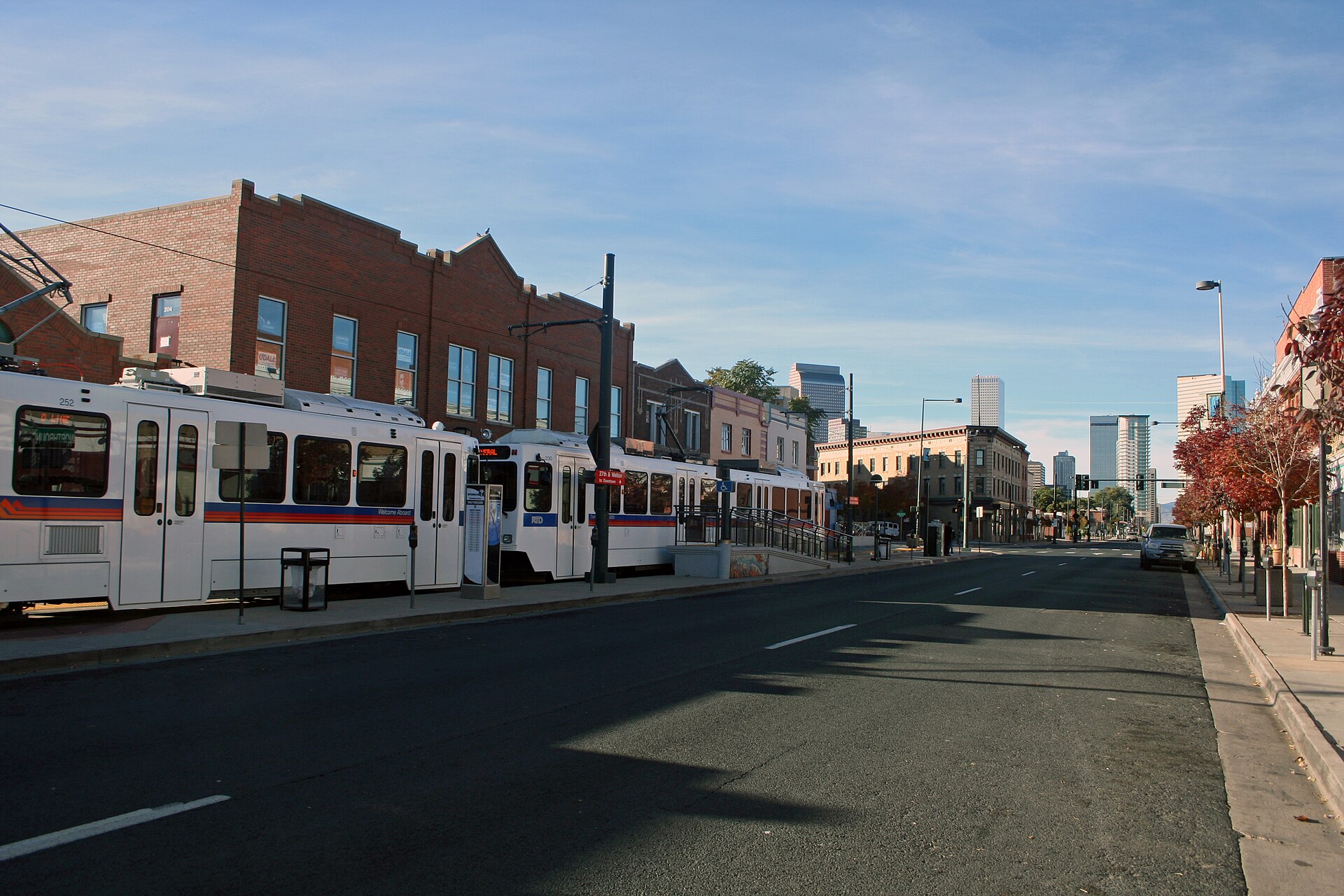
Five Points sits on the northeast side of downtown. As of fall 2026, RTD has suspended light rail at the Welton Street stations and 30th & Downing until its Downtown Rail Reconstruction Project finishes, expected in 2027. Service is changing, so confirm your trip with RTD.
- Into downtown: 20th Street marks the downtown side of Five Points, and the airport rail line also runs from 38th & Blake Station to Union Station.
- Into the Tech Center: I-25 curves around the west side of downtown, with exits at 20th Street and at Park Avenue and West 38th Avenue. Head south and it cuts through the Denver Technological Center.
- Transit: 38th & Blake Station opened in 2016 and has a park-and-ride. The suspended stations include 25th & Welton, 27th & Welton and 30th & Downing. RTD names Route 43 as the alternative, running between Central Park Station and the Auraria campus.
- The airport: RTD's airport rail line runs from 38th & Blake Station to Denver Airport Station. By car, take I-70 east to Peña Boulevard. A 2022 project replaced the I-70 viaduct between Brighton and Colorado boulevards and added express toll lanes.
- The mountains: I-70 has an exit at Brighton Boulevard, which runs through RiNo. Go west past the Mousetrap interchange with I-25, and the freeway heads into the Rockies along Clear Creek.
Where does RiNo and Five Points start and stop?
The official lines come from Denver's statistical neighborhoods, which city agencies use for data, research and records. District names don't change that map. On that map, this area is Five Points, bordered by the Central Business District, City Park West, Cole, Elyria-Swansea, Globeville, Highland, North Capitol Hill, Union Station and Whittier.
Five Points
The Denver Public Library traces the neighborhood north along Downing Street to 38th Street, northwest to Ringsby Court, then back southeast along 20th Street. A small portion wraps around Coors Field. Go by the city's map for a specific address. The name comes from the intersection of Washington Street, 27th Street, 26th Avenue and Welton Street.
RiNo
RiNo is a nonprofit arts organization and registered neighborhood organization, not a statistical neighborhood. Its footprint sits in Five Points and reaches into parts of Globeville and Elyria-Swansea, and the Art District's own materials and the Denver Public Library also name Cole. So a RiNo address can land in more than one city neighborhood.
Curtis Park
These blocks along Champa, Curtis, California and Stout streets were among the earliest in Denver, and most buildings went up between 1885 and 1890. The National Register of Historic Places listed the Curtis-Champa Streets district in 1975 and expanded it in 1983. Denver has eight local historic districts named Curtis Park A through H, designated from 1995 to 2011.
Arapahoe Square
This area runs along the edge of downtown, bounded by Park Avenue, 20th Street, the alley between Welton and Glenarm streets, and the alley between Larimer and Lawrence streets.
Ballpark
Coors Field's opening brought housing, mixed-use buildings, restaurants and bars. Larimer Street between 20th Street and Park Avenue serves as a main street. The Ballpark Neighborhood historic district, designated in 2002, protects the warehouse character of older buildings.
Welton Street corridor
North of 24th Street, Welton is a main street corridor at the heart of Five Points. Denver designated the Five Points Historic Cultural District in 2002, and you may also see it called the Welton Street Cultural Historic District.
Five Points' history is tied to Denver's Black community. African American railroad workers from Georgia had settled on 22nd Street by the 1870s, and by the 1920s the great majority of Denver's African American residents lived in Five Points and Whittier, limited by custom and restrictive covenants to the area around the Five Points intersection. Welton Street was the heart of that community, with more than fifty bars and clubs in the jazz years. Segregation often kept Black touring musicians out of the hotels where they performed, so they lodged in Five Points and played there too, and the neighborhood became known as the Harlem of the West. The Rossonian, built in 1912 as the Baxter Hotel and sold and renamed in 1929, hosted Duke Ellington, Ella Fitzgerald, Billie Holiday and Louis Armstrong.
Other communities are part of this history too. Temple Emanuel built its synagogue at Curtis and 24th streets in 1882, and the Burlington Hotel at 22nd and Larimer streets was a first stop for many Japanese Americans.
Nearby areas often confused with it
LoDo is in the Union Station neighborhood, not Five Points. Cole and Whittier sit across Downing Street.
What does it cost to own a home in RiNo and Five Points?
Prices and tax amounts change, so this guide points you to where to check them.
- Property tax: Denver's property search shows assessment and tax data by address, Parcel ID or schedule number. At certain times of year it may leave out maintenance district fees, service lien fees and business improvement fees, so ask about them.
- Improvement districts: RiNo's general improvement district was approved in 2015, mainly on the Brighton Boulevard side, with commercial and residential owners both paying. Ballpark's was created in a November 2024 special election and also taxes both. Business improvement districts such as RiNo's tax commercial property. These lines don't follow neighborhood lines, so go by the tax bill for the address.
- Sidewalk fee: As of its 2025 rollout, all Denver property owners pay this, even on a block with no sidewalk. It's on the municipal stormwater bill, and owners still clear snow, ice and debris.
- Landmark rules: Denver's design guidelines apply to all individually designated landmarks and historic districts, except Lower Downtown, which has its own. Here that includes the Curtis Park, Ballpark Neighborhood and Five Points districts, plus individual landmarks such as Sacred Heart Church at 2760 Larimer St. Check the address before you plan exterior work.
- Older-home systems: Denver Water's address lookup shows a property's risk of lead in drinking water, and its Lead Reduction Program replaces lead service lines with copper. Radon can enter a home from the soil beneath it, so test for it. Get a sewer scope on any older house.
- HOA or condo dues: In a shared building, find out what the dues cover, including trash and recycling, and who pays the stormwater bill. When an HOA handles that bill, it handles the sidewalk fee too.
- Parking: Find out whether the block has permit rules and, in a loft building, whether a space comes with the unit.
- Flood insurance: FEMA's Flood Map Service Center lets you search the official flood map by address.
What kinds of homes are in RiNo and Five Points?
Expect a wide range within a short distance. Curtis Park has small and large rowhouses, large single-family homes and small cottages, mostly masonry, in styles such as Italianate, Second Empire, Queen Anne and Eastlake. After the economic panic of the 1890s, more modest homes went up in Five Points. In RiNo and Ballpark, the story is newer: industrial and warehouse buildings turned into lofts and apartments, plus a lot of new construction.
How do schools work in RiNo and Five Points?
Five Points is in Denver Public Schools. Some parts of Denver use a single-school boundary and others use an enrollment zone, where an address guarantees a seat at one of several schools, not one specific school. Enter each address you're considering into DPS's School Finder to see which applies, including any RiNo address outside Five Points.
What is there to do in RiNo and Five Points?
Parks, trails and open space
Mestizo-Curtis Park, named for Samuel Curtis, was established in 1868 as Denver's first public park, on just under 2.5 acres. Sonny Lawson Park sits at Park Avenue West and Welton Street, and a 2013 renovation added ball field fencing and exercise equipment. In neighboring Whittier, Fuller Park became Denver's second public park in 1879.
Events
Denver Arts & Venues' annual Five Points Jazz Festival has been held on Welton Street between 25th and 29th streets, so check the current date and details. Otha Rice brought the Juneteenth celebration to 28th and Welton in the early 1950s.
Food and shops
In RiNo, look for restaurants, bars and boutique shops, including along parts of Larimer Street. Larimer continues into Ballpark, where restaurants and bars followed Coors Field. Welton Street north of 24th is a main street corridor in Five Points.
Three places to start
- Rossonian Hotel — Built in 1912 and renamed in 1929, it dominates the Five Points intersection.
- Blair-Caldwell African American Research Library — At 2401 Welton St., a full-service branch library with archives on the second level and the Western Legacies Museum on the third.
- Mestizo-Curtis Park — Denver's first public park, established in 1868 in Curtis Park.
Who are the big employers in and near RiNo and Five Points?
The nearest job center is next door: downtown's central business district shares a border with Five Points, and so does the Union Station neighborhood. Coors Field is inside the Ballpark improvement district. RiNo has its own business improvement district, founded in 2015. RTD's Route 43 connects Central Park Station with the Auraria campus. Employer rosters change, so treat these as places to look rather than a ranked list.
How does RiNo and Five Points compare with nearby areas?
- RiNo and Five Points vs. LoDo — LoDo is in the Union Station neighborhood. Its Lower Downtown Historic District dates to 1988 and has its own guidelines and review process.
- RiNo and Five Points vs. Whittier — Downing Street is the line. Five Points grew up as a mix of homes, businesses and industry, while Whittier was almost entirely residential from the start, with commerce in brick corner stores.
- RiNo and Five Points vs. Cole — Cole also sits across Downing Street. It's one of Denver's oldest neighborhoods, platted as Ford's Addition in 1871.
- RiNo and Five Points vs. Globeville and Elyria-Swansea — Both are separate statistical neighborhoods that RiNo reaches into. Elyria and Swansea were annexed into Denver in 1902, and I-70 and I-25 pass through Globeville.
Buying in RiNo and Five Points: what to do first
- Get pre-approved before you tour. A Curtis Park rowhouse, a converted loft and a new build are different purchases, and knowing your numbers tells you which ones to look at.
- Confirm the neighborhood. Check the address on Denver's map, since a RiNo address may be in Five Points, Globeville, Elyria-Swansea or Cole.
- Pull the records. Use Denver's property search for assessment and tax data, and look for any improvement district on the tax bill.
- Check the historic status. Find out whether the address is in a historic district or is an individual landmark before you plan exterior work.
- Inspect for the home's age. Get a general inspection, a sewer scope and a radon test, and run the address through Denver Water's lead lookup. Then check FEMA's flood map, the block's parking signs and DPS's School Finder.
- Veterans: If you're using a VA loan, plan for the appraisal on an older house. VA must ensure a financed home is suitable for dwelling purposes, and its minimum property requirements can expose defects or maintenance issues. If you'd like a read on current pricing for the blocks you're considering, reach out and I'll walk you through it.
In pictures
Watch the videos
Help shape what Jimmy films next
Which town should Jimmy cover next, and what do you still want to know? Tell us, and we'll email you when the guide and video are out.
Thank you — this genuinely helps. We'll let you know when it's ready.
Frequently asked questions
Is RiNo the same as Five Points?
No. Five Points is an official Denver statistical neighborhood. RiNo, the River North Art District, is a district inside it that also reaches into parts of Globeville and Elyria-Swansea.
Where does Five Points start and stop?
The Denver Public Library traces it north along Downing Street to 38th Street, northwest to Ringsby Court, and back southeast along 20th Street. Check Denver's statistical neighborhood map for a specific address.
Is there light rail in RiNo and Five Points?
38th & Blake Station is on RTD's airport rail line, between Union Station and Denver Airport Station. Light rail at the Welton Street stations and 30th & Downing is suspended during RTD's rail project as of fall 2026, so confirm service with RTD.
What school district is Five Points in?
Five Points is in Denver Public Schools. DPS uses boundaries in some areas and enrollment zones in others, so enter the specific address in its School Finder.
Is Curtis Park a historic district?
Yes. Denver has eight local districts named Curtis Park A through H, and the Curtis-Champa Streets district is on the National Register of Historic Places. They may not cover every block, so check the specific address.
What is a general improvement district?
It's an area where properties are taxed to fund neighborhood improvements. RiNo's and Ballpark's both reach residential property, so check the tax bill for the specific address.
What should I check before buying an older home here?
Get a general inspection, a sewer scope and a radon test, and run the address through Denver Water's lead lookup. Then check Denver's property search, historic status and FEMA's flood map.
Take this guide with you
Get the printable PDF version to read offline, share with your family or mark up on your scouting trip. Enter your name and email and it's yours.
Thanks! Your guide is ready.
Download the PDFNo spam. Jimmy may follow up personally to see if you have questions about the move.
Sources
Guide reviewed November 3, 2026, and reviewed again twice a year.
- Wikipedia: Five Points, Denver (location, subareas, RiNo footprint, Sonny Lawson Park, Coors Field edge, 38th & Blake opening)
- FOX31 via Yahoo: Why RiNo and LoDo aren't listed in Denver's neighborhoods (how Denver's statistical neighborhoods work; the boundary source for this guide)
- RiNo Art District: About (founding, nonprofit status, Colorado Creative District, neighborhoods served, BID and GID)
- RiNo Art District: Historic Neighborhoods (Five Points, Cole, Globeville, Elyria and Swansea)
- RiNo Art District: RiNo GID (what the district funds)
- Denver Public Library: Five Points-Whittier Neighborhood History (boundaries, name, early history, African American community, Welton Street, Juneteenth, first and second public parks)
- Denver Public Library: Jazz in Five Points, A Brief History, Part One, July 5, 2022 (Harlem of the West, Welton Street venues, Rossonian)
- Denver Public Library: River North Art District (RiNo), Feb. 22, 2021 (neighborhoods the district is part of)
- Denver Public Library: Curtis Park Historic District (dates, styles, building types)
- The Cultural Landscape Foundation: Curtis Park Historic District (streets, Samuel Curtis and the 1868 park, National Register dates)
- History Colorado: Rossonian Hotel, National and State Register entry (1912, Baxter Hotel, 1929 renaming, jazz history)
- Denver Public Library: About the Blair-Caldwell African American Research Library (address, levels, collections)
- City and County of Denver: Northeast Downtown Neighborhoods Plan, adopted 2011 (Arapahoe Square bounds, Ballpark, Welton corridor, district names)
- Wikipedia: List of Denver landmarks (historic districts, designation years, individual landmarks)
- RTD: Rail Project FAQs (light rail suspension, Route 43, effective June 7, 2026)
- RTD: Final September 2026 Service Changes (suspension through project completion in 2027, Union Station to Denver Airport)
- Wikipedia: L Line (RTD) (station list, 38th & Blake park-and-ride)
- Wikipedia: Interstate 70 in Colorado (Brighton Boulevard exit, Mousetrap, Peña Boulevard, viaduct and toll lanes, route through the Rockies)
- Wikipedia: Interstate 25 in Colorado (exits, route around downtown, Denver Technological Center)
- BusinessDen: RiNo voters OK higher taxes to fund improvements, Nov. 6, 2015 (RiNo GID vote, who pays, area)
- Denver Gazette: Denver Ballpark improvement district measure approved, Nov. 7, 2024 (GID vs. BID, who pays)
- CBS Colorado: Ballpark Denver General Improvement District, March 2025 (district created, includes Coors Field)
- Denver Arts & Venues: Five Points Jazz Festival 20th Year, June 6, 2023 (presenter, annual event, Welton Street blocks)
- Denver Public Schools: Enrollment Zones (zones, School Finder)
- City and County of Denver: Property Search (assessment and tax data, fees that may not appear)
- Denverite: Denver sidewalk fee FAQ, December 2024 (who pays, billing, HOAs, snow removal)
- City and County of Denver: Landmark Preservation Design Guidelines (when they apply, Lower Downtown exception)
- Denver Water: Lead Reduction Program (address lookup, line replacement)
- Colorado Department of Public Health and Environment: Radon
- FEMA Flood Map Service Center (flood map search by address)
- Federal Register: VA Minimum Property Requirements notice, Dec. 11, 2023 (purpose of the requirements)
- Destination Denver Colorado: Touring the Best Denver Neighborhoods (Jan. 2025), Jimmy's own observations
- Destination Denver Colorado: Moving to Denver or to Fort Collins (2025), Jimmy's own observations
Photo credits
- The Rossonian Hotel building on Welton Street in Five Points, Denver: Jeffrey Beall, CC BY-SA 2.0, via Wikimedia Commons.
- Light rail station at 27th and Welton streets in Five Points, Denver: Jeffrey Beall, CC BY-SA 3.0, via Wikimedia Commons.
Thinking about moving here?
Ask Jimmy anything about the area, the neighborhoods or the move itself. No pressure, just straight answers from a local.


